Transforming NHS Operational Planning Through Integrated Modelling
How The PSC supported an NHS trust to develop a more integrated, evidence-based approach to three-year operational planning, aligning activity and performance targets with deliverable decisions and finance and workforce plans.
With tighter national planning deadlines and a shift towards three-year planning, an NHS trust partnered with The PSC to strengthen its financial and operational planning processes.
Working as an integrated team, The PSC supported the trust to develop a more joined-up, bottom-up approach, using modelling to inform operational decisions and create plans that were both ambitious and deliverable.

The Challenge
Historically, the trust's planning process had been largely top-down, centrally coordinated and led by finance, with workforce and operational plans developed somewhat separately. There had been limited engagement at divisional and specialty level, and previous plans had often gone off course early in the year.
The trust needed to mobilise quickly to meet tighter national submission deadlines, while upskilling a relatively new and evolving team. England published its Medium-Term Planning Framework in 24 October 2025, so the trust needed to start planning without national templates or confirmed planning assumptions.
The Medium-Term Planning Framework also introduced three-year planning horizons, which added further complexity. This required the organisation to consider not only its immediate priorities but how improvements would be delivered over several years.
Crucially, the trust wanted to move beyond projecting historical performance forward and adjusting figures to meet targets. Instead, it sought to use the planning process to actively shape decisions about operational activity, investment and performance improvement.
Our Approach
The PSC worked closely with the trust's finance, operational and analytics teams, embedding expertise within the existing team to develop a single, integrated activity and performance model.
Rather than modelling individual performance metrics separately, the team developed a core model using divisional financial planning returns as a single source of truth. This meant the activity plan held no additional activity that wasn’t funded or backed by a specific productivity scheme, and ensured greater alignment between financial, workforce and activity plans.
The model covered all of the Trust’s specialties over three years and reflected interdependencies. Specifically, it modelled how planned activity translated into performance drivers, including waiting list clock stops and bed occupancy, that were then used to project each specialty’s waiting list by bands (< 18 weeks, 18-52 weeks, and >52 weeks) and emergency department performance, including four-hour and 12-hour waits.
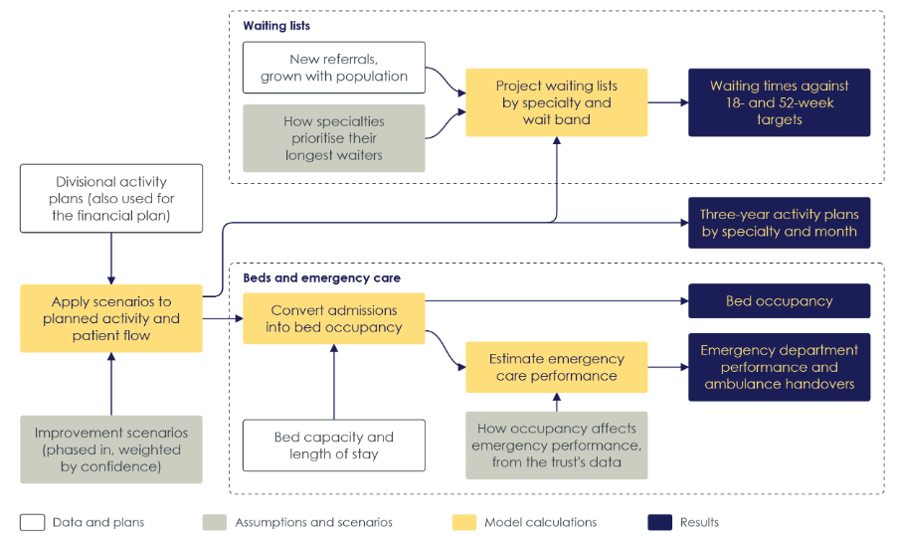 Figure 1: Divisional plans and improvement scenarios produce three-year activity plans and drive projected performance, at both trust-wide and specialty level.
Working alongside the trust's divisional engagement process, The PSC used the model to:
- Identify gaps between planned activity and national performance targets, including referral-to-treatment waiting times – showing each specialty its own trajectory and what it would take to close the gap.
- Model different scenarios and interventions, from delivering the core plan to more ambitious improvement, testing interventions such as Ambient Voice Technology (AVT), advice and guidance, and a digital front-door.
- Highlight where changes in clinical and operational processes were needed, rather than assuming additional resources alone would improve performance.
- Assess the phasing and deliverability of improvements across the three-year planning period, helping teams identify where further action was required and where improvements were less likely.
This approach enabled the trust to move towards a more evidence-based planning process, where performance ambitions were underpinned by specific decisions and operational changes.
The Change
The PSC's support was "instrumental" in helping the trust prepare its first planning submission within the required deadline, while establishing a more coherent and integrated approach to medium-term planning.
“Thank you so much for your work on this, it really has been fundamental to getting us to the first submission”
– Senior executive, acute NHS foundation trust
By building its activity and performance projections on the same divisional returns as its financial plan, the trust gained a clearer understanding of the relationship between its planned resources, operational decisions and performance ambitions.
The approach also helped shift planning conversations from simply meeting numerical targets towards identifying the interventions needed to deliver sustainable improvements.
In particular, the model made trade-offs visible and showed the limits of adding activity without changing how it was delivered or prioritised. More activity at trust level wouldn’t improve waiting times in every specialty unless it reached the patients waiting longest. Similarly, extra inpatient activity was either undeliverable or risked added pressures on beds and making emergency department and ambulance handover targets harder to meet, unless the trust reduced its length of stay and optimised patient flow.
The PSC exists to make public services brilliant. If you would like to discuss how we can support your organisation to develop a more integrated, evidence-based approach to operational planning, get in touch with us.