Blueprint for Left Shift: Reflections from NHS Confed
Following their NHS Confed session, Erica Daley and Christy Francis join Joe Norbury to answer audience questions on Hull and East Riding's Home First transformation, discussing what it takes to successfully shift care closer to home.
Following their session at NHS Confed, Erica Daley, Place Director for Hull at Humber and North Yorkshire Integrated Care Board, and Christy Francis, Chief Operating Officer at City Health Care Partnership CIC, joined Joe Norbury to continue the discussion and answer questions from delegates.
The conversation focuses on the practical considerations behind delivering a large-scale shift in care, including the relationship between acute and community services, the role of partnership working, sequencing investment and the challenges of implementing change across organisational boundaries.
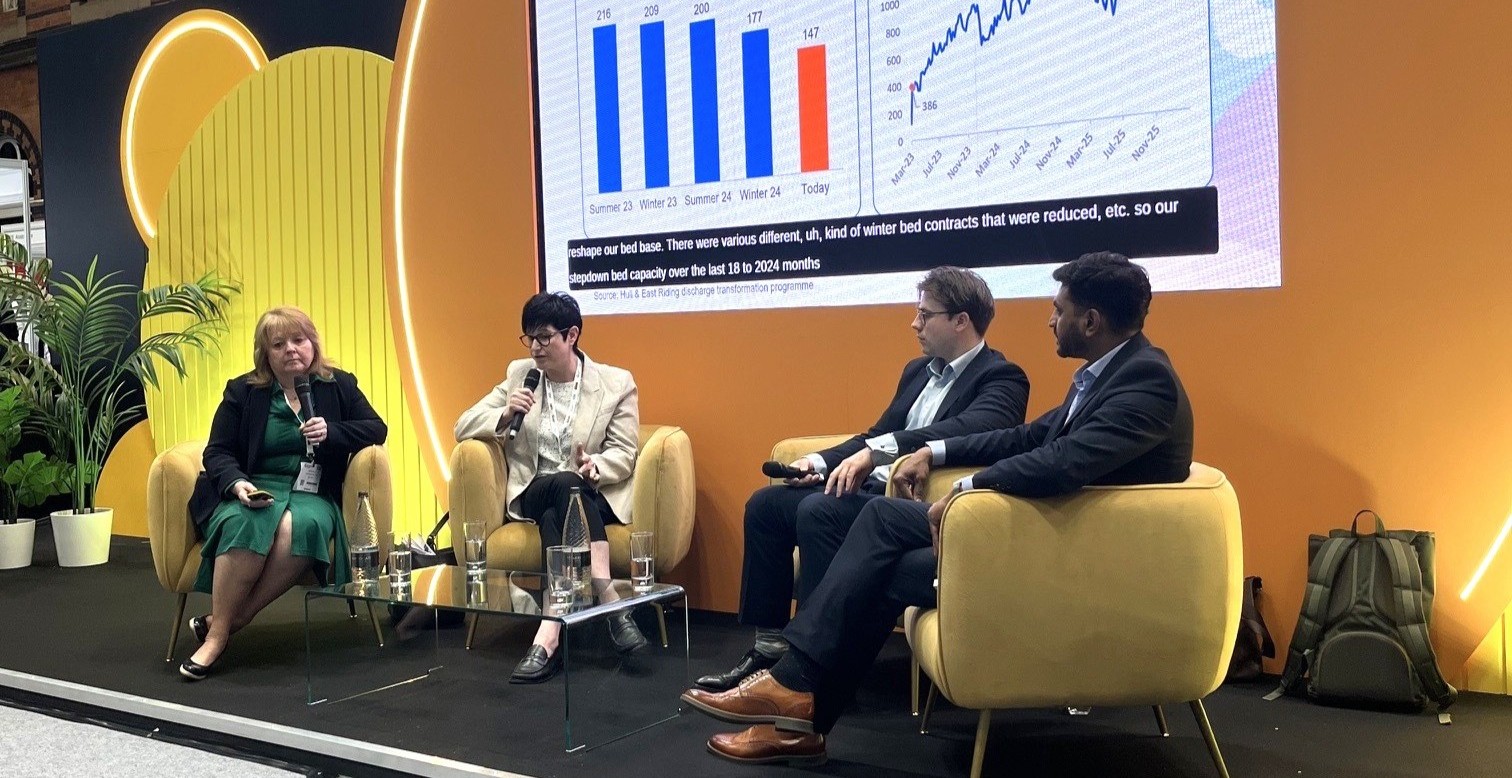
What stood out at NHS Confed?
Joe begins by asking what conversations stood out after the NHS Confed session.
Erica and Christy reflect that many delegates were asking similar questions about implementation rather than policy direction. The ambition to move more care into communities is well established, but discussion focused on how systems can make that shift in practice.
Questions centred on the relationship between hospital capacity and community services, how organisations worked together across traditional boundaries, and what conditions needed to be in place before significant change could happen.
Rather than discussing a single intervention, the conversation reflects the complexity of changing an entire health and care pathway.
What does Home First mean in practice?
Joe asks Erica and Christy to summarise the approach taken in Hull and East Riding.
They explain that the programme considered the whole pathway rather than focusing solely on discharge from hospital. The starting point was understanding how people could be supported to recover at home safely, with services organised around that objective.
The discussion describes how this required organisations from across health, social care and the voluntary sector to plan collectively, considering the capacity needed across the whole system rather than within individual organisations.
This meant redesigning pathways alongside investment in community services, with decisions informed by demand and capacity modelling and shared planning across partners. For more detail on the Home First discharge transformation programme, read our case study.
Can capacity really shift from hospital into the community?
One of the questions from delegates focused on whether capacity and resources can realistically move from acute settings into community care.
Erica explains that the sequence is important. Community services need to be established and able to meet demand before hospital capacity can safely reduce. Throughout the conversation, both speakers emphasise that investment came first, allowing confidence to build in alternative pathways before beds were removed.
Christy adds that this was not a short-term programme but a multi-year piece of work that allowed partners to test approaches, understand demand and adapt services over time.
The discussion highlights the practical considerations involved in shifting capacity across a system rather than treating community investment and hospital flow as separate issues.
How did organisations work together differently?
Joe also asks what enabled organisations to work across traditional boundaries.
Both speakers describe the importance of creating time and space for partners to understand the pressures facing different organisations and to develop a shared understanding of the challenges they were trying to address.
The conversation highlights the role of shared governance, joint decision-making and common objectives, alongside continued engagement between health, local government and voluntary sector partners.
Rather than discussing collaboration as an abstract principle, Erica and Christy describe it as something that required consistent leadership, regular conversations and shared ownership throughout the programme.
What should other systems consider?
The final discussion focuses on the questions delegates were asking about applying similar approaches elsewhere.
Rather than presenting a single model, Erica and Christy reflect on the importance of understanding local context, building relationships between organisations and taking a whole-system view of patient pathways.
Throughout the discussion, they return to the importance of sequencing change appropriately, using evidence to inform decisions and maintaining a focus on how services work together rather than viewing individual organisations in isolation.
Conclusion
Across the conversation, Erica Daley and Christy Francis discuss the relationship between hospital and community services, the role of partnership working, and the importance of sequencing investment when redesigning pathways. Together, the discussion offers an insight into the practical considerations involved in shifting care closer to home and the questions that many systems are now exploring as neighbourhood health continues to develop.
The PSC exists to make public services brilliant. If you'd like to find out more about the Home First discharge transformation programme or to discuss how we can support your organisation through our Left Shift Demand and Capacity diagnostic, get in touch with Joe Norbury.
Latest News & Insights
Building from the bottom up: Lord David Blunkett’s Kerslake Memorial Lecture
At our Third Kerslake Memorial Lecture, Lord David Blunkett explored devolution and the future of…

The PSC in Conversation: Turning health data and technology into better care
Caroline Cake, CEO and Co-Founder of Kneu Health and The PSC alumna, joins Antonio Weiss to discuss…

The PSC in Conversation: Putting people at the heart of their care: Patient editable access on the Universal Care Plan
Since patient editable access to London's Universal Care Plan launched through the NHS App,…