Building from the bottom up: Lord David Blunkett’s Kerslake Memorial Lecture
At our Third Kerslake Memorial Lecture, Lord David Blunkett explored devolution and the future of public services, before joining Antonio Weiss for a lively Q&A shaped by questions from the room and online.
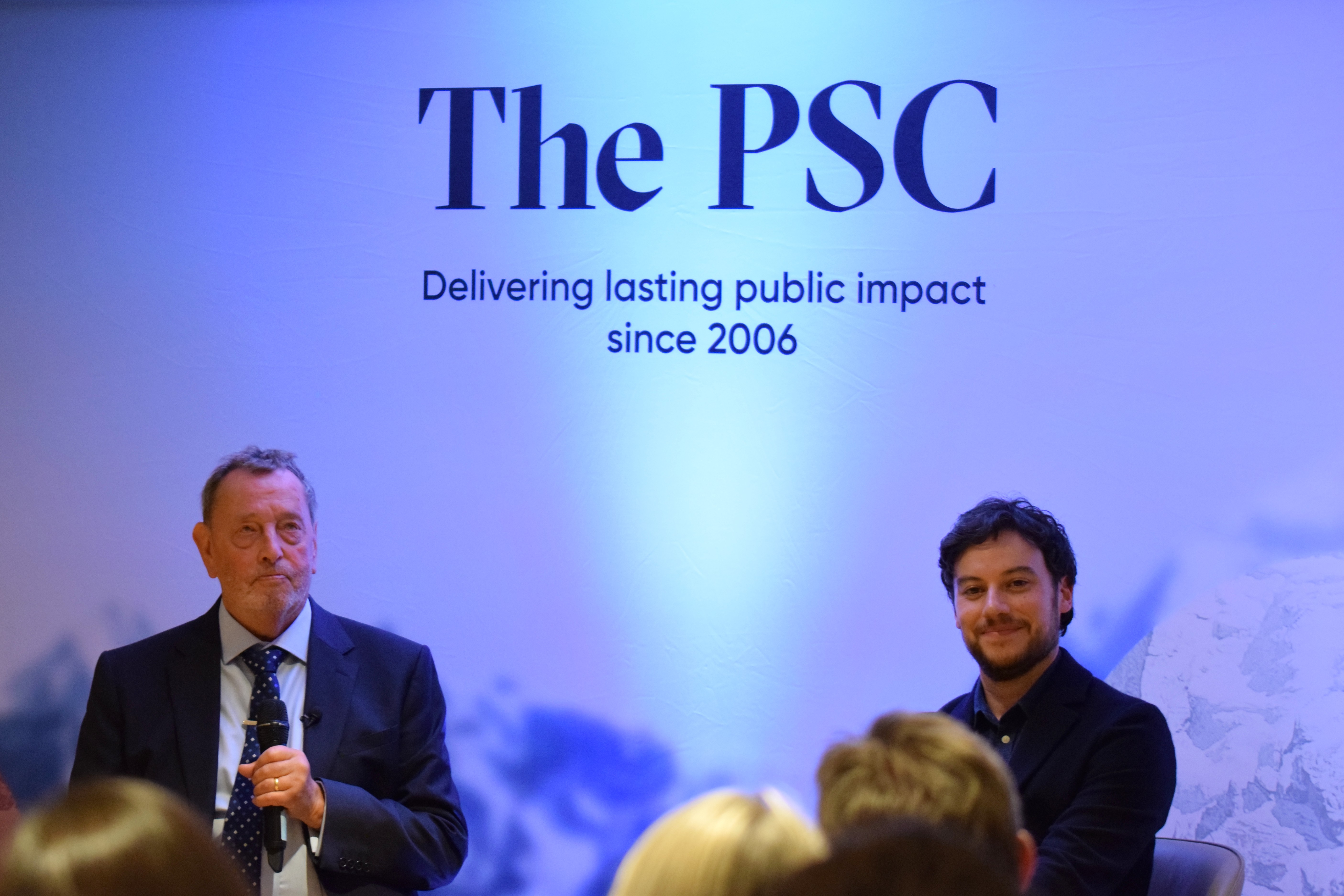
Last month, we welcomed The Rt Hon Lord David Blunkett to deliver The PSC’s Third Kerslake Memorial Lecture, our annual event held in memory of our former Chair, Lord Bob Kerslake. The evening opened with a warm welcome from The PSC founder Russell Cake, before Anne Kerslake shared some personal reflections on Bob, his life and enduring legacy, and introduced David to deliver this year’s lecture.
David’s lecture began with Bob himself – remembering a public servant who combined leadership at the highest levels with a determination to understand what was happening on the ground. From there, he explored what that approach might teach us about the future of public services, and particularly the relationship between national government, local leaders and communities.
His central argument was that meaningful devolution needs to go beyond moving administrative responsibilities around the system. It should give people and places greater influence over the services that affect them, supported by the resources, accountability and national partnership needed to make that work.
Public service rooted in communities
Reflecting on Bob’s time in Sheffield, David recalled his willingness to go directly into neighbourhoods and understand what people needed.
“He didn't sit in a town hall behind a desk. He got his hands dirty by coming and listening and learning and promising and delivering to people.”
That approach provided a starting point for the lecture. David argued that bringing services closer to people should mean more than simply changing which institution is responsible for delivering them; it should also change the relationship between public services and the people who use them.
He spoke about designing services with people rather than for them, creating greater opportunities for engagement, co-production and local decision-making.
“It was all about how you develop services at local level and engage people where they want to be engaged to the point where they feel that the service has got something to do with them.”
David made the case that place matters because communities are different. Effective public services need to recognise those differences while maintaining fairness and access to the support people should be able to expect wherever they live.
Devolution means accepting different decisions
But giving places greater freedom inevitably creates tensions. In his lecture, David argued that genuine devolution means accepting that local leaders will sometimes make choices that national government would not have made itself.
“You devolve some power, some influence, and some resources, and then you discover that the people you've devolved to don't share your view of the direction in which you're supposed to be going.”
The challenge is therefore to be clearer about the parameters within which local decisions can be made, where national responsibilities remain, and who should ultimately be held accountable.
This clarity matters not only when things go wrong. David suggested that people also need to know where they can take ideas, suggestions and contributions – making accountability part of a more constructive relationship between communities and public institutions.
National support and local freedom
David made the case that devolution does not mean national government stepping away. Using the example of Sure Start, he reflected on the potential of programmes that combine national resources with joined-up local delivery and meaningful community involvement.
“It was also about engaging people in their community and making them part of the answer, building on the strength of community rather than seeing people as the weakness.”
The wider argument was for a partnership between different levels of government – establishing where national coordination and resources add value while creating sufficient freedom for places to respond to their own circumstances.
That also means learning from what works. David reflected on examples of communities that had successfully transformed their own areas with external support, arguing that public services need to become better at carrying successful approaches from one place to another rather than repeatedly starting again.
Creating space for public service leaders to act
The discussion following the lecture brought these ideas back to the people leading public services today. Asked by Antonio what a council leader, NHS chief executive or senior civil servant could do differently, David encouraged leaders to remember why they entered public service and consider how they could use the authority they already have to make change happen.
“I came into this because I cared, because I wanted to make a difference.”
Rather than simply accepting established ways of working, he argued for listening to colleagues, developing alternatives and creating the conditions for people across organisations to contribute ideas.
Later, discussing how government could work more effectively across organisational boundaries, he returned to the importance of focusing on solutions.
“I don't want you to come with the problem. I want you to come with the answer.”
That requires clearer ownership and accountability, but also permission for people to experiment, learn and act.
Doing it together
David ended where much of the lecture had begun – with the relationships between different parts of the system.
“It's got to be national and local together. It's got to be sub-regional and local together. It's got to be local government and people in their communities together.”
David emphasised that the opportunity is not simply to transfer responsibilities between institutions, but to build a different relationship between national government, local government and communities – one rooted in clearer accountability, meaningful involvement and a shared responsibility for improving public services.
It was an argument closely connected to the approach he remembered in Bob Kerslake: listening, learning and focusing relentlessly on delivery.
And his closing message captured that spirit simply: “You can do it, we can do it, and we can do it together.”
The PSC exists to make public services brilliant. To be first to hear about future lectures and related events - and to receive practical insights on public services - sign up to The PSC newsletter and follow us on LinkedIn.
Latest News & Insights
The PSC in Conversation: Turning health data and technology into better care
Caroline Cake, CEO and Co-Founder of Kneu Health and The PSC alumna, joins Antonio Weiss to discuss…

The PSC in Conversation: Putting people at the heart of their care: Patient editable access on the Universal Care Plan
Since patient editable access to London's Universal Care Plan launched through the NHS App,…
What we heard at the UK Earth Observations Conference: from data supply to use
Insights from the UK Earth Observation Conference on a sector rich in data – and the challenge of…