UK Party Conferences 2025: Competing Visions for the Future of Public Services
From investment to reform, we unpack what the main UK political parties pledged for public services - from health, education, immigration and beyond.
In the autumn 2025 conference season, the UK’s major parties - Labour Party, Conservative Party, Liberal Democrats and Reform UK - laid out divergent visions for public services. What emerges is a clear contrast between investments and modernisation, cost-cutting and decentralisation, as well as competing claims over who should deliver and pay for those services. In this blog, The PSC has teamed up with Strand Partners to distil the key messages from these four party conferences across six areas: health and social care, sustainability and climate change, digital and data, immigration, education, and space and defence. We’ve also included a short summary at the end covering the Scottish National Party’s (SNP) key pledges.

Read on for a more in depth summary of the key takeaways, or view our summary infographic.
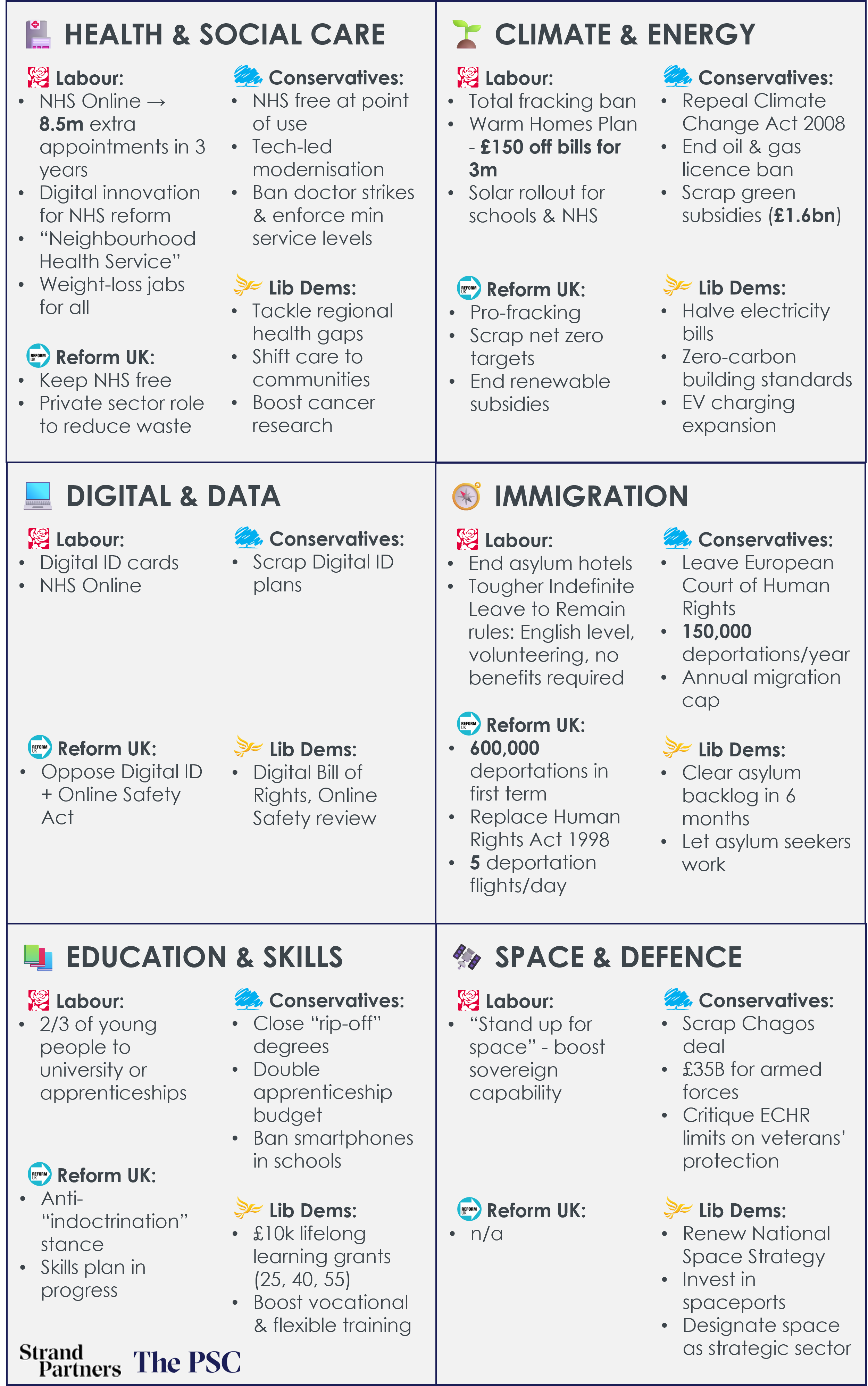
1. Health and Social Care
1.1 Labour
The Labour Party saved its biggest announcement in health for the Prime Minister’s speech:
- Keir Starmer revealed plans for a new NHS Online, which he claimed would deliver up to 8.5 million extra appointments in its first three years.
- Wes Streeting, the Health Secretary, argued that it would help the NHS ‘move with the times’, and highlighted existing government investment in AI, robotic surgery and digital devices for the health service – digital innovation was a core theme of the NHS 10-Year Plan, published in July.
- Streeting also claimed that the NHS should be a ‘Neighbourhood Health Service as much as a National Health Service.’
- Streeting suggested that weight-loss jabs would be made widely available on the NHS to ensure that the best healthcare is available ‘not just to some but to all.’
1.2 Conservative
Stuart Andrew, Shadow Health Secretary, reasserted to Conference that:
- The NHS would ‘always be free at the point of use’ under a Conservative government.
- Lord Markham, a Conservative peer and former health minister, would be advising the party on how government could use technology ‘to build a truly 21st century national health service’.
- The party also announced proposals to legislate for minimum service levels (which the Conservatives originally introduced in 2023, but Labour committed to scrapping in office) and ban doctors from striking to protect patient safety.
1.3 Liberal Democrats
Lib Dem Conference focused on regional inequalities. It carried a ‘Leading the Way’ motion, which recognised the ‘stark and persistent regional inequalities’ in healthcare across the country, and committed to improving primary care, shifting more care out of hospitals and into communities.
Ed Davey also used his Leader’s speech to promise to boost funding for cancer research in the UK and pass a Cancer Survival Research Act to ensure funding for research into the deadliest cancers.
1.4 Reform
Nigel Farage has previously expressed a need to ‘re-examine the whole funding model’, however at Conference Zia Yusuf reaffirmed that the NHS would still remain free at the point of use.
Yusuf also signalled a greater role for private providers, who, he claimed, would help to solve the problems of waste in the NHS. However, there was some controversy around the choice of keynote speaker on health - Covid vaccine-sceptic Aseem Malhotra, who claimed that the vaccine could be linked to the cancers of the Royal Family.
2. Sustainability / Climate Change
2.1 Labour
In his animated speech on net zero, Ed Miliband announced:
- A ‘total ban’ on fracking, going beyond the current moratorium and vowed to send this batch of ‘frackers packing’.
- The extension of the Warm Homes Plan through this winter, meaning 3 million ‘working people’ will get £150 off their energy bills this winter.
- That Great British Energy will deliver solar panels to an additional 45 schools and 50 NHS sites this year, on top of the 400 already announced.
2.2 Conservative
After Kemi Badenoch’s pre-Conference announcement that the Conservatives would repeal the 2008 Climate Change Act, which set targets for cutting carbon emissions, Shadow Secretary of State for Energy Security and Net Zero Claire Coutinho outlined three Conservative principles for energy:
- To back British innovation
- To protect nature
- To prioritise clean, abundant energy – including repealing the Climate Change Act.
The party also pledged to end Labour’s ban on new oil and gas licences and scrap the government’s ‘costly and ineffective’ green subsidies, claiming it would save £1.6 billion.
2.3 Liberal Democrats
Lib Dem members passed a policy motion to deliver a green transition that is ‘good for people, good for the planet, and good for prosperity’. The motion called on the government to:
- Tackle the climate and nature emergencies equally, rather than pitting one against the other.
- Halve electricity bills by investing in renewables, expanding grid capacity, and reforming the energy market to decouple gas and electricity costs.
- Set zero carbon standards for all new buildings and accelerate electric vehicle adoption with expanded charging infrastructure.
2.4 Reform
Reform’s new mayor of Lincolnshire, Andrea Jenkyns, called for the UK to ‘drill, baby, drill’. Leader Nigel Farage has already pledged to scrap net zero targets, bring fracking back to the UK, and increase drilling in the North Sea – he promised to ‘end full subsidies on renewable energy’ and ‘reindustrialise Britain’.
Deputy Leader Richard Tice called the idea that human activity contributes to global warming ‘absolute garbage’, and argued that the nation’s top priority should be reducing energy bills, not sustainability.
3. Digital & Data
3.1 Labour
Digital and data was a persistent theme of Labour’s Conference, with the Prime Minister relying on digital transformation for his mission to ‘renew’ Britain. Starmer announced the introduction of Digital ID cards for work on the Friday before Conference – though it did not feature in his speech, which instead focused on NHS Online and the broader theme of renewal.
3.2 Conservative
The Conservatives opposed Labour’s Digital ID card policy and pledged to scrap it in office as part of the party’s belief in ‘individual liberty and responsibility.’
3.3 Liberal Democrats
Conference passed a policy motion in favour of a new approach, which ‘puts people, rights, and safety first’. It called for:
- A full Parliamentary review within six months to examine whether the Online Safety Act is meeting its stated aims, whether it is fit for purpose, and what reforms including further legislation are needed.
- Stronger scrutiny of Ofcom’s implementation to ensure regulations focus on tackling real online harms, not blocking access to politics, education, or wellbeing resources.
- A new Digital Bill of Rights to safeguard privacy, free expression, and protection against online harms - ensuring online regulation works for people, not against them.
The Liberal Democrats later opposed Labour’s plan for Digital ID.
3.4 Reform
Though Reform Conference took place before the government’s announcement of Digital ID cards, the party strongly opposed them in principle:
- David Bull, Chairman, labelled them a sign of ‘a dystopian society – a police surveillance state.’
- Reform UK continue to vociferously reject the idea that Digital ID can transform public services and immigration policy, and also argue against the Online Safety Act, which it considers ‘borderline dystopian’.
4. Immigration
4.1 Labour
At Labour Party Conference Home Secretary Shabana Mahmood outlined new measures to strengthen border control and manage migration:
- Committed to ending asylum hotels and reviewing legal constraints on immigration.
- Announced that Indefinite Leave to Remain would require 10 years of residence, with more conditions including work, National Insurance, no benefits, English proficiency, no criminal record and local volunteering.
4.2 Conservative
The Conservatives set out proposals that would tighten border control, reduce migration and speed up removals:
- The UK would leave the European Court of Human Rights.
- A new Removals Force would deport 150,000 people a year who have no legal right to remain, with illegal arrivals and foreign offenders removed within a week. Visa sanctions would be used against countries refusing to comply.
- The Immigration Tribunal would be abolished, and judicial reviews and legal aid in immigration cases would be restricted to prevent repeat appeals.
- A binding annual immigration cap would be approved by Parliament each year, aiming for negative net migration.
4.3 Liberal Democrats
Ed Davey proposed an emergency plan to address the asylum backlog and improve the system’s efficiency:
- Pledged to clear the asylum backlog within six months through temporary process centres and by tripling the number of caseworkers, arguing that this plan would save money and reduce reliance on asylum hotels.
- Proposed giving asylum seekers the right to work while their claims are being processed.
4.4 Reform
Reform laid out a hard line immigration agenda focussed on mass removals, stricter legal frameworks and greater state control over migration:
- Proposed removing 600,000 asylum seekers during first term in office via deportation agreements with other countries.
- Planned exiting the ECHR and replace the Human Rights Act with domestic British Bill of Rights.
- Envisioned a new ‘UK Deportation Command’ modelled on ICE in the US to manage large scale deportations.
- Pledged to schedule up to 5 deportation flights per day.
5. Education
5.1 Labour
The Government’s major education announcement was made in the Prime Minister’s speech:
- Starmer announced a new ambition that 2/3 of young people should either go to university or take a ‘gold standard’ apprenticeship, marking a notable departure from Tony Blair’s stated target that 50% of young people going to university.
5.2 Conservative
In relation to higher education courses, Kemi Badenoch promised to ‘shut down these rip-off courses and use the money to double the apprenticeship budget.' She argued that one in three graduates see no economic return from their degree, and claimed that each year taxpayers are writing off more than £7 billion in unpaid student loans.
Meanwhile, Shadow Education Secretary Laura Trott called for a ban on smartphones in schools, telling Bridget Phillipson to ‘just get on and do it.’
5.3 Liberal Democrats
A Conference motion argued that ‘across the country, people are being held back not by a lack of potential, but by a lack of access to the training they need to succeed’, and pledged:
- A £10,000 Lifelong Training Grant for every adult, available in instalments at ages 25, 40, and 55, to support re-skilling and career transitions.
- Reforming Skills England into a truly independent body, accountable to Parliament and driven by regional and sectoral expertise.
- Guaranteeing apprentices are paid at least the National Minimum Wage, and scrapping the lower apprentice rate.
- Extending the Pupil Premium to post-16 further education learners and equalising per-student funding with school sixth forms.
- Creating Skills Cooperatives for small businesses to pool training resources and transforming the Growth and Skills Levy into a Skills and Training Account model to empower both employers and individuals to fund training.
- Boosting vocational qualifications, micro-credentials, and modular learning to give people more flexible routes to success.
- Speeding up recognition of people’s existing qualifications when they move to the UK, so they can use their skills here.
5.4 Reform
Zia Yusuf told Conference of the need to prevent schools becoming ‘indoctrination camps’. He promised the ‘most audacious skills programme in history’ to train British workers for jobs that would otherwise be filled by migrants. The Party claimed that a full plan for education was ‘being worked on.'
6. Space & Defence
6.1 Labour
UKspace, the UK’s space trade association, held several fringe events in Liverpool. Kevin Bonavia, Labour MP for Stevenage, argued that the party ‘must stand up for space.’ Tan Dhesi MP, Chair of the Defence Select Committee, added that the UK must ‘think about our own sovereign capability.’
6.2 Conservative
Shadow Defence Secretary James Cartlidge pledged to scrap Labour’s Chagos deal and instead spend £35 billion on the British armed forces. He also argued that remaining in the ECHR makes it impossible to fully protect veterans and service personnel from ‘vexatious claims.’
6.3 Liberal Democrats
Lib Dems passed a policy motion to ‘put the UK space sector back on track’, warning that ‘without urgent action, we risk seeing opportunities and investment go elsewhere.’ The motion called on government to:
- Renew the National Space Strategy, focusing on attracting international investment, fostering growth, and ensuring people-centred, efficient regulation.
- Review and support UK spaceports and hubs to cement the UK’s place as a global space hub.
- Designate space as a strategic industry under the National Wealth Fund.
6.4 Reform
There were no major announcements relating to Space and Defence at the Reform Party conference.
In addition to the above, they key takeaways from the Scottish National Party (SNP) Conference for public services were:
- Walk-in GP network: Plans for a nationwide system of walk-in GP services, open from noon to 8 p.m., seven days a week, staffed by doctors and nurses. Fifteen initial sites to open within a year, providing over one million extra appointments.
- Social care workforce: Government sponsorship for skilled overseas workers already in the UK but unable to work due to visa restrictions, allowing them to take up roles in social care.
- Independence: Reaffirmation of the SNP’s commitment to Scottish independence, emphasising that decisions about Scotland should be made in Scotland and referencing recent policy work on the economic and constitutional case.
- International and defence policy: Continued support for humanitarian and education programmes overseas, alongside a restated opposition to nuclear weapons in Scotland.
The PSC has been delivering lasting impact to public services since 2006. If you are interested in understanding more about our services or how we can support your organisation, get in touch with us at hello@thepsc.co.uk.
Latest News & Insights.

Synthetic Research is Happening – Here’s What’s Out There
AI-powered synthetic research is moving fast. Here’s how public service…

The PSC and Parkinson’s UK Shortlisted for The 2026 HSJ Partnership Awards
Our Time-Critical Medications Dashboard has received recognition from The 2026…

Fit for the Future: Realising the ‘Left Shift’ from Hospital to Community
Insights from The PSC’s roundtable on community health, innovation and system…