The NHS Medium Term Planning Framework 2026-27: The Key Takeaways
Last week, the NHS published the Medium Term Planning Framework on 'delivering change together' for 2026/27 to 2028/29. In this infographic we summarise the key takeaways and implications for ICBs and Trusts.
The NHS England Medium Term Planning Framework (2026/27–2028/29) sets out a clear, mission-led roadmap to restore elective performance, strengthen prevention, and accelerate digital transformation. It focuses on returning 92% of patients to treatment within 18 weeks by 2029, while driving three major strategic shifts - from hospital to community care, treatment to prevention, and analogue to digital delivery.
Alongside ambitious targets for urgent care, cancer, diagnostics, and primary care, the framework introduces new financial reforms and a rules-based planning system to improve productivity, transparency, and accountability across the NHS. We've summarised the key takeaways into an infographic - or find the plain text version below.
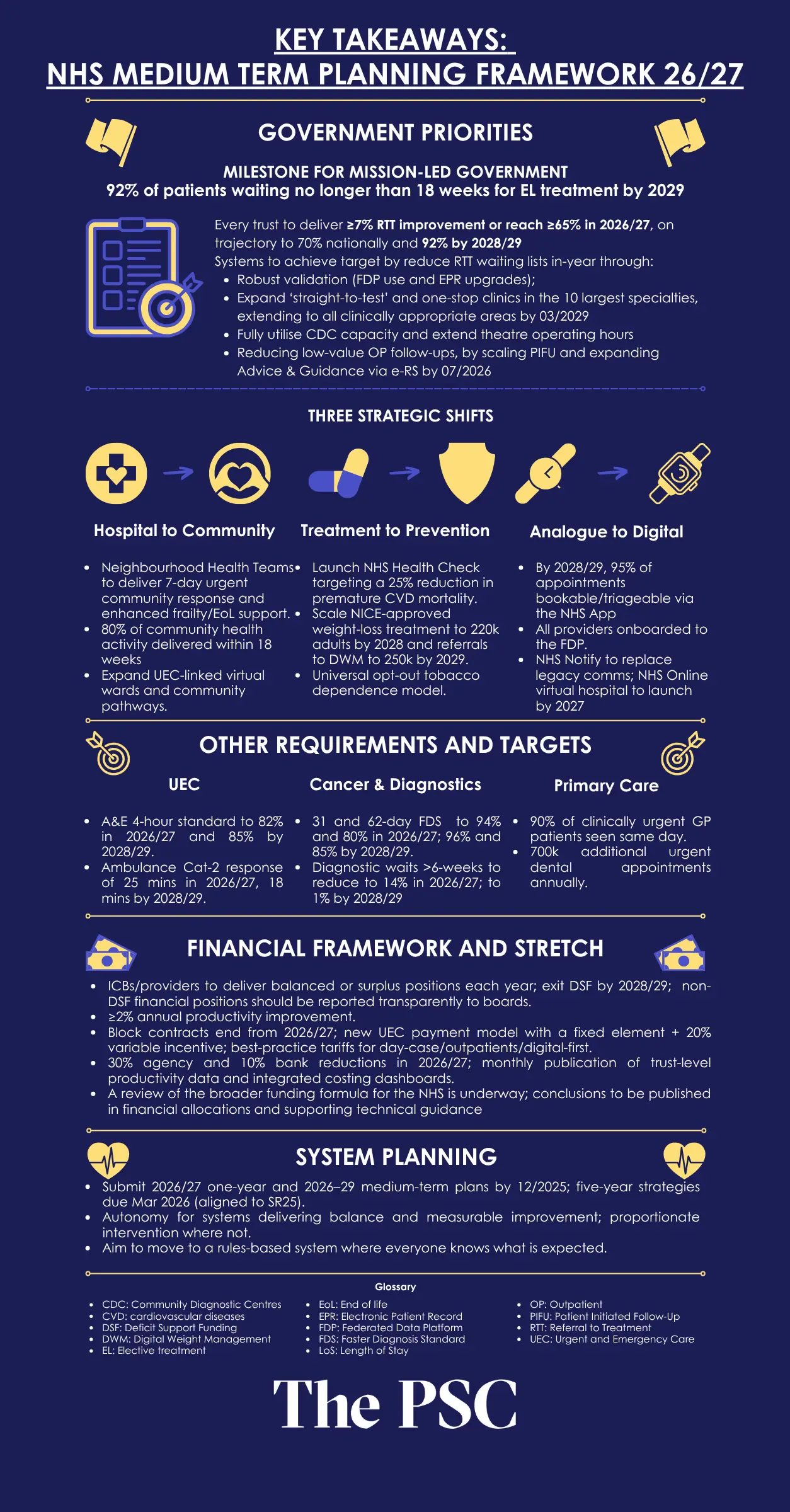
Government priorities (elective recovery)
The overall milestone for a mission-led government is to return to 92% of patients waiting less than 18 weeks for elective treatment by the end of 2029. In 2026/27 every trust must either deliver ≥7% referral to treatment (RTT) improvement or reach ≥65% RTT performance, as part of the trajectory to 92%.
Systems are asked to shorten waiting lists by:
- Scaling Advice & Guidance via e-RS by July 2026
- Federated Data Platform (FDP) use and Electronic Patient Record (EPR) upgrades
- Cutting low-value follow-ups through PIFU
- Expanding straight-to-test /one-stop clinics in the 10 largest specialties
- Fully utilising diagnostic and theatre capacity, including extending theatre hours
Three strategic shifts
-
Hospital to community: Establish Neighbourhood Health Teams, expand seven-day urgent community response, and ensure ≥80% of community health activity occurs within 18 weeks by 2028/29.
-
Treatment to prevention: Launch the online NHS Health Check with the aim of a 25% reduction in premature CVD mortality; expand access to NICE-approved weight-loss treatment to ~220,000 adults by 2028 and increase Digital Weight Management referrals to 250,000 a year by 2029; move to a universal opt-out tobacco dependence model.
-
Analogue to digital: By 2028/29, 95% of NHS appointments should be bookable or triageable via the NHS App; all providers onboarded to the Federated Data Platform; NHS Notify replaces legacy communications; NHS Online virtual hospital launches by 2027.
Other requirements and targets
Urgent & Emergency Care
- Improve A&E 4-hour performance to 85% by 2028/29 (with 82% in 2026/27) and reduce 12-hour waits.
- Improve Ambulance Category 2 mean response times to 25 minutes in 2026/27 and 18 minutes by 2028/29.
Cancer & diagnostics
- Reach 94% for 31-day standard for cancer treatment (start treatment within 31 days of decision to treat cancer) and 80% for the 62-day standard (start treatment within 62 days of urgent referral) in 2026/27, rising to 96% and 85% respectively by 2028/29.
- Reduce diagnostic waits greater than 6 weeks to 14% in 2026/27 and to 1% by 2028/29.
Primary care
The framework states a new ambition that 90% of clinically urgent GP patients are seen same day. There will also be 700k additional urgent dental appointments per year.
Financial framework and payment reform
ICBs/ providers are expected to deliver balanced or surplus positions each year, exit deficit support funding (DSF) within the planning horizon (2029), and deliver ≥2% annual productivity improvement.
Block contracts are to end from 2026/27, with a new Urgent Emergency Care (UEC) payment model (fixed element plus 20% variable incentive) and the introduction of best-practice tariffs to support day-case/outpatient/digital-first models.
Overall there will be greater financial transparency: monthly trust-level productivity statistics will be incorporated into the NHS Oversight Framework, and integrated costing dashboards will be published. There is expected to be transparent reporting of non-Deficit Support Funding (DSF) to boards where DSF is in place.
System planning
Overall planning will move to a 'rules-based system where everyone knows what is expected and what follows.' Systems are to submit 2026/27 one-year and 2026–29 medium-term plans before Christmas 2025 (first submission: 3-year numerical returns and board assurance), while final plans, including five-year strategy, are due by March 2026. Plans are assured by NHS England regional teams and must triangulate activity, workforce and finance.
Learn More
The PSC has delivered lasting impact to public services since 2006. If you have any questions about the NHS England Medium Term Planning Framework 2026/27 - 2028/29 or want to discuss how we can support your organisation in delivering the requirements, contact us at hello@thepsc.co.uk.
The detailed Medium Term Plannig Framework is available on the NHS England website.

Latest News & Insights.

Synthetic Research is Happening – Here’s What’s Out There
AI-powered synthetic research is moving fast. Here’s how public service…

The PSC and Parkinson’s UK Shortlisted for The 2026 HSJ Partnership Awards
Our Time-Critical Medications Dashboard has received recognition from The 2026…

Fit for the Future: Realising the ‘Left Shift’ from Hospital to Community
Insights from The PSC’s roundtable on community health, innovation and system…