22/12/2025
Insights
2025 Wrapped: What This Year Tells Us About the Next 20 for Public Services
From healthcare reform to AI acceleration, in our end of year podcast, The PSC team discuss a year of signals, shifts and renewed optimism for public services.
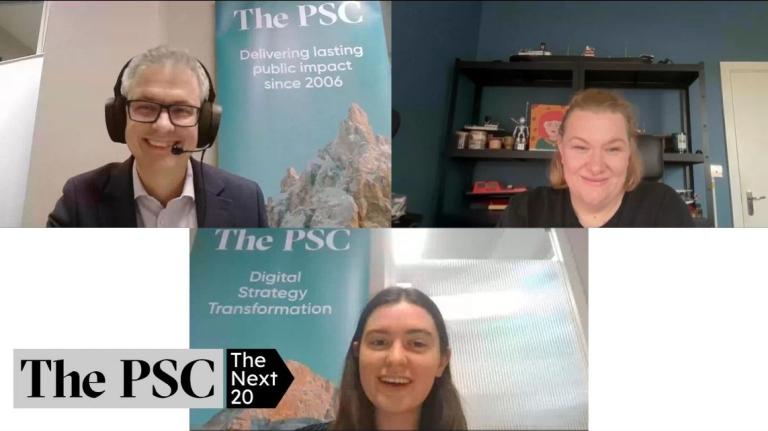
As the year draws to a close, Antonio Weiss is joined by David Chappell and Jessica Solomon on The PSC in Conversation podcast to pause, reflect and look ahead. This annual wrap episode is always one of our favourites, not just because it gives us a chance to take stock of a busy year, but because it helps us connect the dots between policy, practice and the lived reality of public services.
2025 has been a year of big moments – the Labour government marking one year in office, a landmark 10 Year Health Plan for the NHS, and rapid advances in artificial intelligence moving from hype towards everyday use. And, for us at The PSC, a year of growth, learning and impact as we continue our mission of making public services brilliant.
This conversation also marks the start of something special. In 2026, The PSC turns 20. To celebrate, we are launching our Next 20 series, asking a simple but challenging question – what do the next 20 months need to look like if we are to secure a better next 20 years for public services?

A pivotal year for health and care
Health and care loomed large in 2025, and rightly so. The publication of the NHS 10 Year Health and Care Plan for England set the direction of travel for at least the next decade, and in many ways, longer. While much of the detail is still to be worked through, the plan sent some clear and important signals.
One of the most striking was the positioning of the NHS App as the digital front door to healthcare. With around 32 million people already having downloaded it, the potential scale is unprecedented. The challenge now is turning reach into real value – using digital tools to make access simpler, care more joined up and experiences more human, not less.
Value based healthcare was another major milestone. Its formal launch in NHS England brings it into alignment with approaches already underway in Scotland and Wales. The emphasis on patient reported outcomes, experiences and incentives that reward what matters most to people reflects a welcome shift away from activity alone and towards genuine impact.
Mental health also felt different this year. Rather than being treated as an add-on, it is increasingly embedded into the core of how services are designed and delivered. From expanded mental health support teams in schools to dedicated mental health emergency departments, the direction of travel is clear. This was reinforced through our own work on improving culture on inpatient mental health wards – supporting staff wellbeing, reducing burnout and creating more therapeutic environments for service users.
Taken together, these developments point to a system beginning to grapple seriously with long standing challenges – moving care closer to the community, shifting from treatment to prevention, and designing services around people rather than institutions.
Technology moves from promise to practice
If 2025 will be remembered for one thing, it may well be the year artificial intelligence became unavoidable. Three years on from generative AI entering the public consciousness, the conversation has matured. The government’s AI Opportunities Action Plan set out ambitious goals around adoption, productivity and inclusion, while debates around digital identity and data infrastructure gathered pace.
For public services, the opportunity is clear – but so are the risks. AI has enormous potential to reduce administrative burden, free up professional time and help people navigate complex systems more easily. Evidence is starting to emerge, such as studies showing clinicians saving significant time each day through the use of tools like Microsoft Copilot.
But none of this works if AI is treated as a bolt-on. It requires whole system change – trusted data, thoughtful governance, and a culture that supports learning rather than fear. At The PSC, we have been grappling with these questions ourselves, through our AI portfolio programme office. This work has focused on setting clear policy, providing training, testing real use cases and, crucially, evaluating whether technology actually makes things better.
The lesson from 2025 is that understanding how AI works matters just as much as deploying it. Guardrails, human-in-the-loop approaches and an honest recognition of limitations are essential if public services are to harness these tools responsibly.
Economics, growth and hard choices
Alongside reform and innovation, 2025 was also a year of tough economic realities. The spring statement and autumn budget underlined the difficulty of reconciling three competing pressures – fiscal rules, commitments to limit tax rises, and promises to improve public services.
Much of the government’s response has been framed around growth and productivity rather than large new spending. Investment in infrastructure, skills, digital transformation and emerging sectors such as smart data and space reflects an attempt to build long term capacity within tight constraints.
The real test, however, will be whether these ambitions translate into tangible improvements on the ground. Productivity gains need to become better experiences for citizens and more sustainable working lives for public servants. That is where delivery, design and implementation matter most – and where public service leaders need support to turn investment into public value.
Why Public Value Design matters
One of our biggest reflections this year has been on what it really takes to deliver lasting change. Too often, initiatives are short term, fragmented or focused on single organisations. Over time, we have learned that large scale, systemic transformation requires a different approach – what we call Public Value Design (PVD).
PVD starts with a simple question – what is the benefit for citizens? From there, it demands an honest engagement with the whole system – multiple organisations, legacy structures, incentives and trade-offs. It recognises that public services are universal, and that accessibility and inclusion are not optional extras but core design principles.
Whether it is joining up health and care data for millions of people or building new digital services in emerging sectors, this approach is about creating value that lasts. As we head into our 20th anniversary year, this will be a central theme of our The Next 20 series.
Looking ahead with optimism
So what does all this mean for 2026 and beyond? There is plenty of uncertainty, but also real grounds for optimism. We are seeing the early signs of a shift towards more preventative, personalised and proactive public services. Technology is beginning to be used in ways that support, rather than replace, human connection. And there is growing recognition that reform must be both ambitious and grounded in evidence.
Twenty years from now, public services will undoubtedly look different – perhaps in ways we cannot yet imagine. But if 2025 has shown us anything, it is that progress comes when we combine bold vision with practical delivery, and when we keep the focus firmly on people.
As we close the year, we want to thank everyone who has worked with us, listened to the podcast and contributed to these conversations. We look forward to continuing them in 2026, as we explore what the next 20 months can do to shape the next 20 years of public services.
Make sure to listen to the full podcast episode on our channel, The PSC in Conversation, on your preferred podcast platform.
Latest News & Insights.
The Next 20: Rethinking Demand – The Role of High Intensity User Services in Urgent and Emergency Care
How the British Red Cross's HIU services are helping shift urgent and emergency…

The Neighbourhood Health Framework: what it means for systems and leaders
The Neighbourhood Health Framework explained – key goals, delivery models and…

The Next 20: Bringing mental health care closer to home
In this episode of The PSC in Conversation, Harris Lorie and Mikoto Nakajima…