The Next 20 Live: Making AI work in public services - from opportunity to impact
AI is already shaping public services – but its value depends on how it is applied. In our latest episode of The Next 20, Antonio Weiss and The PSC alumna Vikie Bew explore impact, risk, trust and what it takes to use AI well in practice.
Artificial intelligence is now firmly part of the public service landscape. The question is no longer whether it will be used, but how – and to what end.
In this special episode of The Next 20, held with a live studio audience, Antonio Weiss speaks with Vikie Bew, former Deputy Director at the UK Government’s Incubator for AI and an alumna of 2020 Delivery (now The PSC), about what it really takes to apply AI in public services.
What emerges is not a story about technology alone, but about judgement – how leaders balance opportunity with risk, how they focus on impact, and how they navigate implementation inside complex systems.

Impact is the mandate – but it has to be real
Early in the conversation, Vikie is clear that AI should not be treated as an end in itself.
“Impact is the mandate.”
What matters is whether something materially improves how public services operate – for citizens and for those delivering them. That means moving beyond experimentation and asking harder questions about what is actually changing as a result.
Antonio draws out the tension between innovation and impact. The conclusion is not to choose between them, but to connect them – innovation only matters if it leads to impact, and impact increasingly depends on innovation. That raises the bar for how AI is used in practice.
Public consultations: a problem shaped for AI
One of the most concrete examples discussed is public consultations – a core part of policymaking, but one that remains highly manual. Consultations often involve thousands of responses, requiring significant effort to read, categorise and synthesise. As Vikie describes it, this is a problem “perfectly shaped” for AI.
Tools like Consult are beginning to change that – AI can process large volumes of responses, identify themes, and support policymakers to move more quickly from evidence to decision. The value is not just speed; it is also consistency, and the ability to engage more fully with what people are saying rather than being constrained by time and resource.
At the same time, the role of AI is carefully defined. It supports judgement rather than replacing it. Decisions remain human – but better informed and less constrained by process.
Risk in public services is different, and so is the response
The conversation then turns to risk, and this is where the public sector context becomes particularly important. Vikie reflects that public services operate with a different risk calculus. The consequences of getting things wrong are often more immediate and more visible, which shapes how new tools are adopted.
Even where the case for AI appears strong, there can be hesitation – not because the technology is unclear, but because the context demands a higher degree of assurance.
At the same time, there is a risk in standing still. Slow processes, administrative burden and inconsistency also have real consequences for citizens. The challenge for leaders is not to eliminate risk, but to balance it – recognising both the risks of using AI and the risks of not using it.
Trust is not designed in but built over time
A particularly thoughtful part of the conversation explores trust. Antonio describes it as a “slippery” concept, and Vikie agrees. Trust in new technologies rarely exists from the outset. It tends to develop over time, through use and experience.
She points to how attitudes to digital banking have evolved. What was once unfamiliar and mistrusted is now routine – not because trust was perfectly designed in from the beginning, but because the system proved itself.
This raises an important question for public services. Rather than trying to solve trust upfront, should leaders focus on demonstrating reliability and value in practice? The conversation suggests that trust is often an outcome rather than a starting point.
Adoption is the real challenge
Even when the case for AI is strong, adoption is not automatic. Vikie reflects that tools like Consult, which many inside government see as obvious improvements, can still face resistance. Some of this relates to risk, but much of it comes down to how change happens in practice.
There is also a gap between internal and external perspectives. Many members of the public would be surprised by how manual some processes still are – and by the scale of the opportunity to improve them.
This highlights a broader point: building tools is only part of the task. Embedding them requires changes in behaviour, confidence and ways of working.
Evaluation brings discipline to AI adoption
Towards the end of the conversation, Vikie highlights the importance of evaluation – something often underplayed in discussions about AI.
At the Incubator, evaluation was taken seriously, with dedicated teams and, where possible, robust methods such as randomised controlled trials. This matters because AI introduces new forms of uncertainty. It is not enough to know that a tool works in theory – it needs to be tested in practice, with a clear understanding of its impact.
Evaluation brings discipline. It helps organisations understand what is working, where value is being created, and where approaches need to change.
Closing reflection
This conversation does not present AI as a silver bullet, but focuses on what it takes to use it well. Impact, risk, trust, adoption and evaluation all sit at the heart of that challenge. None are straightforward, and none can be addressed in isolation.
If there is a common thread, it's that applying AI in public services is less about technology, and more about judgement: knowing where it adds value, being honest about the risks, and being disciplined enough to test, learn and adapt. This is what will determine whether AI delivers meaningful change in practice.
The PSC exists to make public services brilliant. If you want to explore further the opportunities for adopting artificial intelligence within your organisation, please get in touch with Antonio Weiss – we'd love to have a conversation.
Latest News & Insights
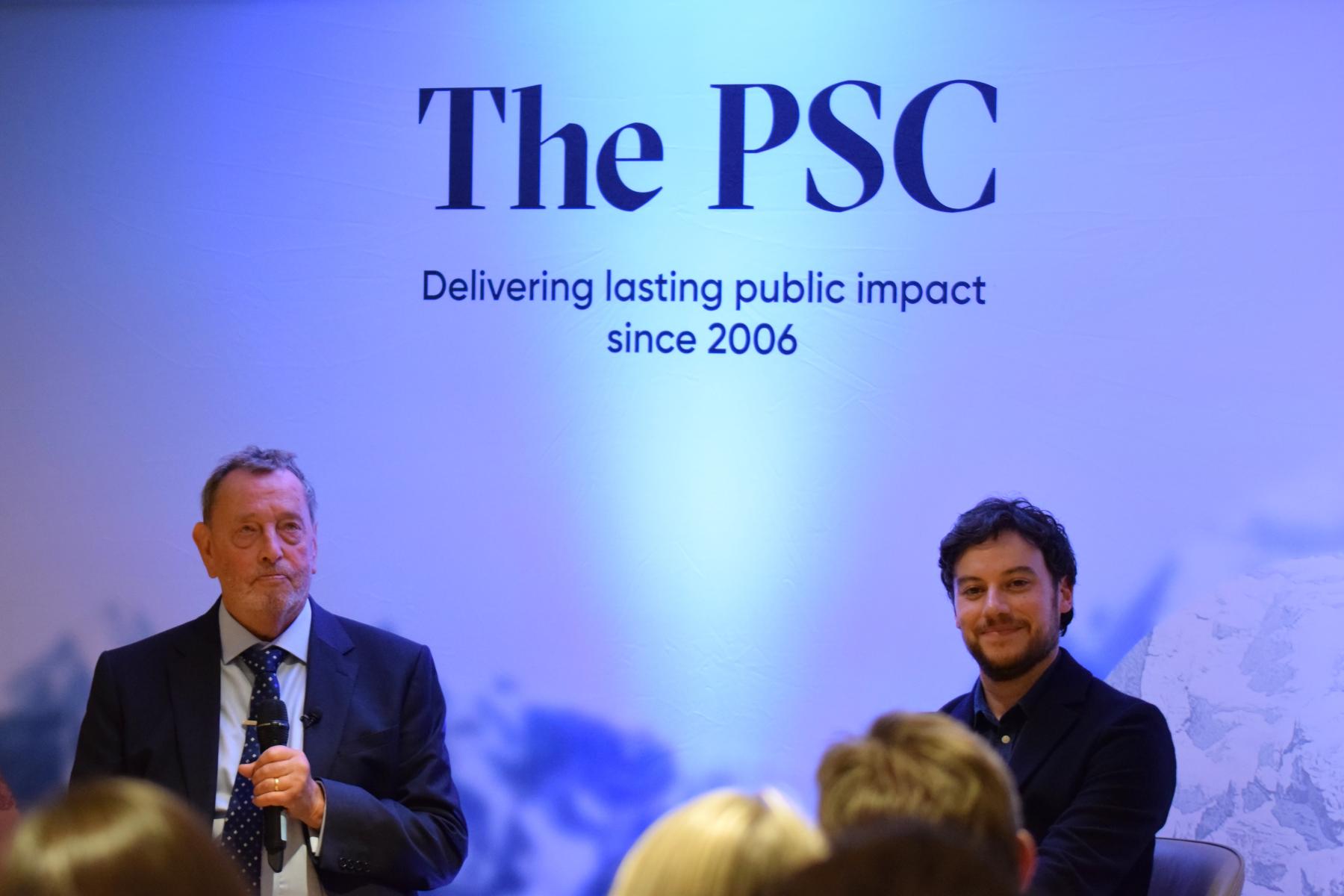
Building from the bottom up: Lord David Blunkett’s Kerslake Memorial Lecture
At our Third Kerslake Memorial Lecture, Lord David Blunkett explored devolution and the future of…

The PSC in Conversation: Turning health data and technology into better care
Caroline Cake, CEO and Co-Founder of Kneu Health and The PSC alumna, joins Antonio Weiss to discuss…

The PSC in Conversation: Putting people at the heart of their care: Patient editable access on the Universal Care Plan
Since patient editable access to London's Universal Care Plan launched through the NHS App,…