The Next 20: What we’ve learned so far – public value design, innovation, and the next steps
After eight episodes of The Next 20, we reflect on the themes shaping public services – from demand and public value to innovation, capability and AI – and what they mean for leaders over the next 20 months and 20 years.
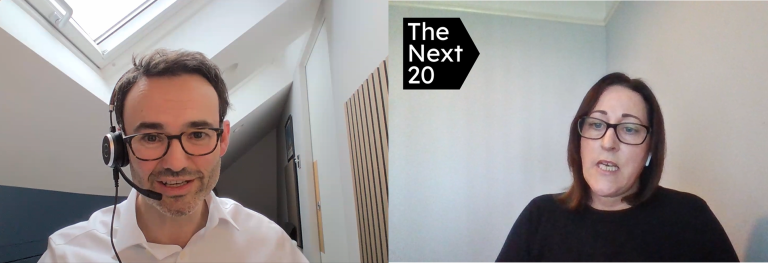
As we continue with our The Next 20 series, in this episode Aoife Clark is joined by Senior Partner Antonio Weiss and Co-founder of The PSC Russell Cake to take a step back to reflect on what we have heard so far from leaders in the public sector. Across conversations spanning community and social care, mental health, innovation, education, debt advice and organisational culture, a consistent set of themes has emerged; public services are facing rising demand, widening expectations and growing complexity, but also that there are practical choices leaders can make now to respond more effectively. While the contexts differ, the underlying challenges, and opportunities, are strikingly similar – below we synthesise the discussion.

21st-century pressures are colliding with 20th-century system designs
Aoife opens with one of the clearest themes running through the series so far: public services are facing 21st-century pressures, but often through 20th-century system designs.
For Russell, the mismatch is most visible anywhere there is “a material mismatch between demand and the ability of the service to keep up.” He points to criminal justice, community health, social care and acute healthcare as examples where both the volume and the complexity of demand have risen, without a corresponding rise in productivity.
For Antonio, demand is only one part of the picture. The other is the widening expectations gap. In a world shaped by smartphones, on-demand services and now AI, public expectations have shifted dramatically. Citizens are increasingly aware not only of what they receive, but of what may be possible.
As he puts it, there is now a growing “dissonance” between what people experience elsewhere and what many public services are currently able to offer.
That leads the conversation quickly to a bigger proposition: responding to new pressures may require more than upgrading old systems. Antonio suggests public leaders should be more willing to think in terms of new institutions and new ways of working – and, just as importantly, to accept that some older models may need to be retired.
“We should be unafraid of saying, well, new 21st-century institutions and ways of working need to come in. It might be okay to retire the old.”
Public value design starts with outcomes, not process
Aoife then turns to a second major thread in the series: public value design.
Drawing on the schools buying strategy episode and the British Red Cross conversation, she highlights a recurring lesson across different contexts: better outcomes come not from abstract efficiency drives, but from designing services around what people actually need and will use.
Russell’s answer is one of the clearest articulations of public value design in the discussion. Public value, he argues, is not just about productivity or efficiency. It starts with meeting user needs, but it also extends beyond that to wider social benefit.
In healthcare, for example, helping someone recover is valuable in itself – but so too is the wider societal value of helping people back into work or reducing pressure elsewhere in the system. Design, then, is about creating services that can hold all of those aims together: useful for users, workable for staff, productive for organisations and beneficial for society.
“It’s about meeting the user’s needs… but it is also about the broader impact on society.”
Antonio then brings this down to earth through the schools buying strategy, which he describes as a vivid example of public value design in practice. The breakthrough did not come from building a more technically sophisticated procurement system. It came from understanding the reality of who was doing the buying in schools, what their day-to-day pressures were, and what they actually trusted.
The insight was simple but powerful: in many schools, the people making buying decisions were not procurement professionals at all. So the design challenge was not just about contracts or frameworks, but about building something credible, useful and trusted by the people actually doing the work.
Technology matters – but only when it is enough, and not more than enough
Unsurprisingly, technology is another central part of the conversation. Drawing on Michelle Corrigan’s point that technology should enable care rather than replace it, and Daniel Kelly’s warning that “automation without empathy” risks alienating those who need support most, Aoife asks Antonio what the conditions are that set technology up to deliver true value design rather than more system noise.
Antonio argues against the instinct to start with the biggest or most ambitious technology solution and then retrofit it to a problem. Instead, he proposes a different mindset: what is the minimum necessary technology to solve the real public value problem?
Borrowing from AI, he talks about the concept of using the smallest model necessary to achieve the outcome required. In public services, he suggests, leaders should ask a similar question: what is the “enoughness” of technology required here?
That may mean a new system – but it may also mean something much smaller: an API, a better data-sharing agreement, or a targeted process fix that removes friction. The point is to begin with the outcome and the minimum viable requirement, rather than with a vendor-led solution looking for a use case.
“What is the enoughness that we need to solve the problem?”
It is a practical intervention in a debate that often swings between over-excitement and over-caution. Technology is necessary, but it is not self-justifying. It has to be proportionate to the problem it is trying to solve.
Reform is not just behavioural – it is multi-component
The episode then moves to behaviour change, productivity and reform – Aoife asks whether public service reform is sometimes misdiagnosed: treated as a technical or structural problem when it is in fact behavioural.
Russell’s answer is careful and important. Yes, there is often a behavioural component, but he resists the idea that the answer is simply to reclassify problems as behavioural. Instead, he argues that difficult behaviours in organisations are often symptoms of something else that is not working, rather than the root cause in themselves.
That “something else” may be system design, technology, roles, workload or wider organisational conditions. In other words, the lesson is not that reform problems are misdiagnosed as technical when they are really behavioural. It is that public service challenges usually have multiple interacting components, and leaders need to understand them in the round.
“Those may often be the symptom of something else that’s not working rather than the root cause of the problem.”
This is one of the more grounded reflections in the discussion. Better behaviours do matter. But they are much easier to sustain in systems designed to support them, and much harder in systems that force staff to work against the grain.
Antonio builds on this with a practical point from transformation work: change cannot be delivered as a one-off training event followed by a launch. Sustainable capability requires ongoing support, coaching, mentoring and a programmatic approach. It takes longer than people would like – but much less time than “hit and hope”.
Innovation is not always about breakthroughs
Aoife then links this to the innovation episode with Jonathan Chappell and the debt advice conversation with Daniel Kelly, drawing out a common thread: innovation is not simply about having good ideas. It is about making change happen in practice.
Antonio’s response distinguishes between two types of innovation that are often blurred together. In some contexts, such as clinical research, innovation may indeed mean breakthrough discovery – something genuinely new that requires different governance, funding and risk tolerance.
But there is another kind of innovation that matters enormously in public services: spreading good practice, embedding it well, and making the basics work consistently.
This is a powerful reframing. He argues that many organisations still struggle with seemingly basic operational disciplines – flow, discharge, end-to-end process design – and that making those things work reliably, in a way that sticks and improves outcomes, is itself a form of innovation.
“It is sadly actually quite innovative and incredibly important to do the basics really well.”
Aoife’s response captures the energy of this idea; innovation, in this reading, is not diminished by being practical – if anything, it becomes more powerful because it is rooted in change that people can feel on the ground.
The real challenge now is prioritisation
The closing section of the conversation shifts from reflection to advice.
Asked for the one thing public service leaders should take away, Russell focuses on selection and sequencing. There is so much change possible, and so much pressure to change, that leaders cannot do everything at once. The critical challenge is to choose a small number of changes, decide the right order, and match ambition to the real bandwidth of leadership teams.
In pressured public service settings, the limiting factor is often not the number of possible improvements, but the capacity to lead them well.
Aoife links that back to Harris Lorie’s point from the Sussex mental health episode: action creates momentum. Starting somewhere concrete, and doing it well, can become the catalyst for broader change.
Three priorities for the next 20 months
Antonio closes with three clear priorities for public service leaders over the next 20 months – and he frames the moment in striking terms, suggesting these may be “the most important 20 months for public services since… the post-war settlement.”
His first priority is to relentlessly focus on public value. Too many services, he argues, are still over-engineered and over-complex, without being sufficiently focused on the true outcome that matters to citizens.
His second is to begin from the reality that the AI era is here. That does not mean AI is the answer to everything, but it does mean it should now be a standard question for leaders to ask: what role could AI play in delivering this service better?
His third is perhaps the sharpest: do not be afraid to stop doing things. Leaders should be willing to look hard at legacy activities that no longer deliver value, and to stop them in order to free up time, cost and leadership attention for what really matters.
“Don’t be afraid to stop doing things.”
The PSC exists to make public services brilliant. In our The Next 20 series we're exploring the opportunities and challenges for public services over the next 20 months and next 20 years alongside leaders spanning a range of fields. Make sure to watch the full episode and follow us on LinkedIn to be notified on our future episodes.
Latest News & Insights
Building from the bottom up: Lord David Blunkett’s Kerslake Memorial Lecture
At our Third Kerslake Memorial Lecture, Lord David Blunkett explored devolution and the future of…
The PSC in Conversation: Turning health data and technology into better care
Caroline Cake, CEO and Co-Founder of Kneu Health and The PSC alumna, joins Antonio Weiss to discuss…

The PSC in Conversation: Putting people at the heart of their care: Patient editable access on the Universal Care Plan
Since patient editable access to London's Universal Care Plan launched through the NHS App,…